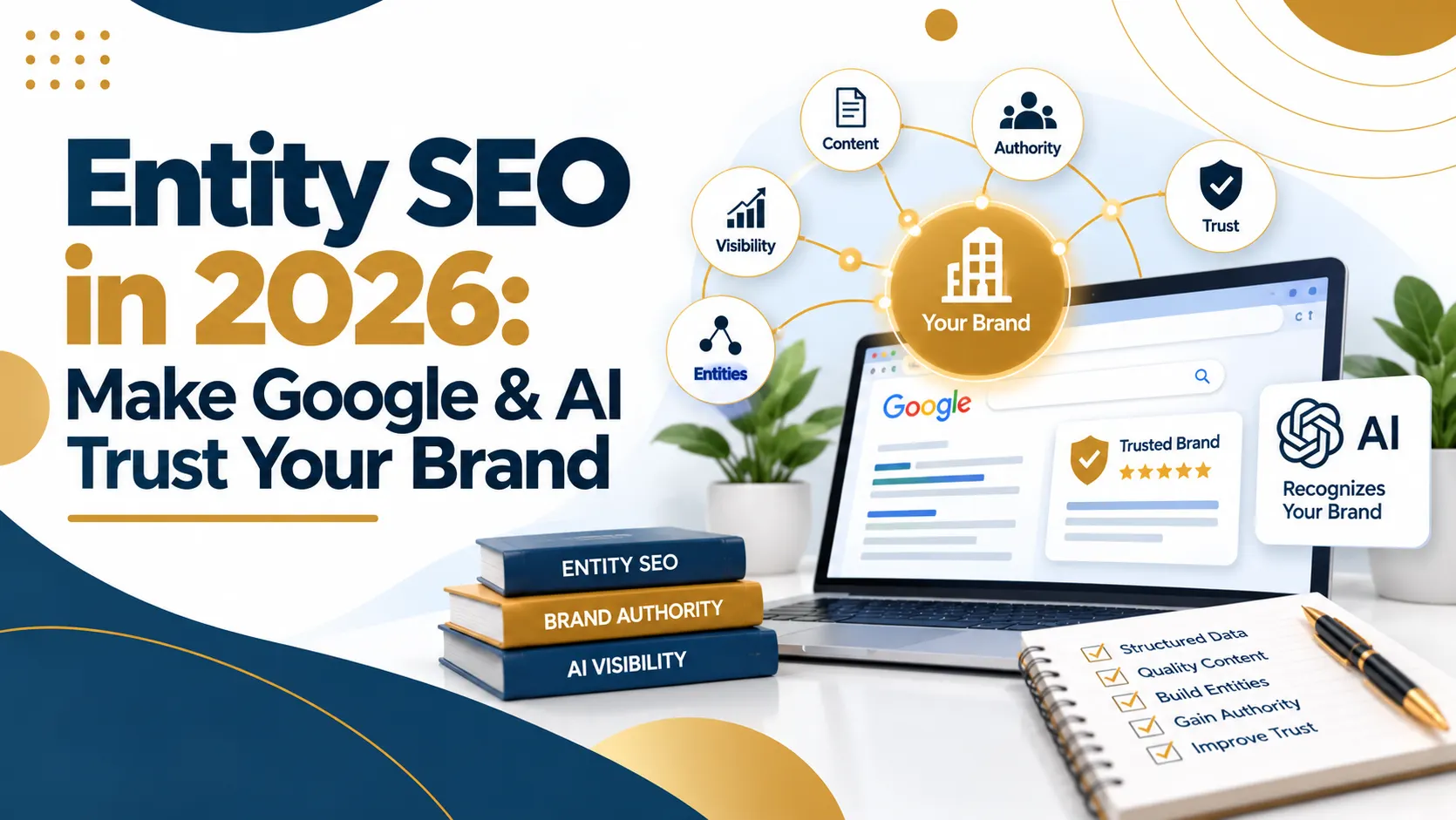
Entity SEO helps search engines and AI platforms understand who your brand is, what it offers and why its information is credible. In 2026, brands need consistent business details, expert-led content, structured data, relevant citations and connected topic coverage to strengthen visibility across traditional search results, Google AI Overviews and other AI-powered discovery tools.
What Is Entity SEO?
Entity SEO is the process of helping search engines understand a distinct subject—such as a company, person, service, product or location—and its relationships with other subjects.
Traditional keyword optimization focuses on the terms people search for. Entity-based SEO adds meaning and context. It helps a search system connect a business with its website, founders, authors, services, locations, case studies and external profiles.
For example, a digital marketing agency is not simply a website that mentions “digital marketing services.” It is an organization connected to:
- An official business name and website
- Founders, employees and content authors
- SEO, PPC, content and web development services
- Office locations and service areas
- Social profiles and business listings
- Articles, case studies and third-party references
Entity optimization does not replace keywords, technical SEO or backlinks. It organizes these elements around a clear and recognizable identity. Understanding how SEO works in digital marketing provides a useful foundation for this broader approach.
Why Does Entity SEO Matter in 2026?
Search behaviour is moving beyond short keyword queries. People now ask detailed questions and expect search engines or AI tools to interpret the meaning behind them.
A user might ask:
- Which agency offers technical SEO for startups?
- Who wrote this marketing advice?
- Which company operates in my location?
- What evidence supports this recommendation?
To answer accurately, search systems need to identify the business, understand its expertise and connect it with relevant topics.
A well-planned entity SEO strategy can help:
- Establish a consistent brand identity
- Clarify services, expertise and locations
- Connect authors with their published content
- Reduce confusion with similarly named businesses
- Build relevance across related subjects
- Support traditional and AI-powered search visibility
Entity optimization does not guarantee a Knowledge Panel, an AI citation or a ranking increase. It creates clearer information that search systems can evaluate alongside content quality, links, reputation and technical performance.
How Do Google and AI Systems Understand Brands?
The Google Knowledge Graph organizes information about identifiable subjects and their relationships. Search systems can also use information from websites, structured data, public business profiles and reputable third-party sources.
Brand understanding may be supported by:
- Homepage and About page information
- Service and location pages
- Google Business Profile
- Author and team profiles
- Organization and Person structured data
- Consistent directory listings
- Internal and external links
- Reviews and reputable brand mentions
The purpose of brand entity optimization is to make these signals accurate and consistent.
If a website uses one business name while external directories contain an old name, phone number or address, search systems receive conflicting information. Essential facts should remain consistent across the website and trusted external profiles.
Local companies should pay particular attention to their name, address, phone number, categories, opening hours and service areas. A relevant local SEO case study shows how local business information and Google Business Profile optimization fit into a wider visibility strategy.
How Are E-E-A-T and Entity SEO Connected?
E-E-A-T represents experience, expertise, authoritativeness and trustworthiness. It is not a single ranking score. Instead, it provides a framework for evaluating whether content appears useful, credible and responsibly created.
E-E-A-T and entity SEO work together when a website makes it clear:
- Who operates the business
- Who created or reviewed the content
- What genuine experience supports the advice
- How the business can be contacted
- Which sources support important claims
- When the information was published or updated
- Whether qualifications can be independently verified
Important articles should display a real author. Each author page should include the person’s full name, role, genuine subject expertise, professional profiles and other published work.
Avoid fictional experts, generic “admin” authors and unverifiable experience claims. Add a reviewer only when a qualified person has genuinely reviewed the content.
How Can You Build an Entity SEO Strategy in Seven Steps?
1. Define the Core Brand Entity
Document the official business name, primary domain, logo, description, founders, key people, contact details, locations, services and official social profiles.
This reference should guide website content, structured data, directory listings and public profiles.
2. Make Business Information Consistent
Review the homepage, About page, Contact page, footer, social profiles and directories. Correct outdated names, addresses, URLs, phone numbers and service descriptions.
The wording can vary, but the underlying facts should not conflict.
3. Create Clear Entity Pages
Important entities deserve dedicated pages. A service business may need:
- About and Contact pages
- Individual service pages
- Team and author profiles
- Location pages
- Case studies
- Topic hubs
- Policy pages
A clear website structure helps people and crawlers understand how these pages relate. The principles in this guide to building an SEO-friendly website can help improve architecture, navigation and crawlability.
4. Build Topical Authority With Content Clusters
Topical authority grows when a website covers its main subjects with useful depth.
Begin with a central pillar or service page. Then create supporting articles that address specific questions, problems and comparisons. An SEO cluster might include technical SEO, on-page optimization, content strategy, schema, local SEO and AI search.
These content clusters should serve real audience needs rather than target every possible keyword variation.
5. Improve Internal Linking for SEO
Contextual internal links help users discover related information and show how subjects connect.
Use descriptive anchor text that clearly represents the destination. For example, readers learning about site quality may benefit from a technical SEO checklist for 2026, while businesses focused on enquiries may need a clearer understanding of SEO lead generation.
Avoid linking unrelated phrases, repeating the same anchor excessively or adding links only to manipulate rankings.
6. Earn Genuine Brand Mentions and Citations
Relevant brand mentions and citations can confirm information about an organization. Useful sources may include:
- Professional associations
- Industry publications
- Partner websites
- Trusted business directories
- Event websites
- Legitimate local media
Prioritize accuracy and relevance. Mass directory submissions, fabricated profiles and purchased mentions can create conflicting information without building genuine authority.
7. Review and Maintain the Entity
Update entity information whenever the company changes its address, leadership, services, domain or official profiles.
Regular checks should cover:
- Website and schema consistency
- Author and employee profiles
- Directory listings
- Broken links
- Old service descriptions
- Google Business Profile details
- Thin or duplicate pages
- Search Console indexing reports
Which Schema Markup Supports Entity SEO?
Schema markup for entity SEO provides machine-readable information about content already visible on a page. It should confirm existing facts rather than introduce hidden claims.
| Schema type or property | Appropriate use |
| Organization | Identifies the company and its official details |
| Person | Identifies a real author, founder or expert |
| Article | Connects an article with its author, publisher and dates |
| FAQPage | Describes visible questions and answers where appropriate |
| BreadcrumbList | Explains the page’s position in the site hierarchy |
| sameAs | Connects an entity with genuine external profiles |
How Should Organization and Person Schema Be Used?
Organization schema can include properties such as name, url, logo, description, address, contactPoint and official profile links. It is normally added to the homepage or primary organization page.
Person schema can identify a real author, founder or subject expert. Connect it to a complete author page and reference that person through the author property in Article markup.
What Is sameAs Schema?
sameAs is a property, not a separate schema type. It connects an entity with another URL that represents the same organization or person.
Use it for genuine social profiles and authoritative identity pages. Do not include unrelated directories simply to increase the number of references.
Valid structured data does not guarantee higher rankings, rich results or inclusion in the Google Knowledge Graph. Google recommends that markup describe visible content and follow its structured-data requirements.
FAQPage markup may describe a visible FAQ section, but Google currently restricts FAQ rich-result visibility mainly to authoritative government and health websites. It should not be presented as a guaranteed visibility tactic.
How Does Entity SEO Support GEO and AEO?
GEO and AEO focus on making content useful and understandable within generative and answer-based search experiences. Entity SEO supports these goals by clarifying the source, author, subject and brand behind the information.
For stronger entity SEO for AI search:
- Answer the main question early.
- Use descriptive question-based headings.
- Publish original explanations and examples.
- Identify authors and reviewers.
- Support factual claims with credible sources.
- Keep names, dates and business details current.
- Use accurate structured data.
- Ensure important pages are crawlable and indexable.
- Add useful images with descriptive alt text.
- Remove vague or unsupported claims.
There is no special schema that guarantees AI search visibility. Google’s guidance explains that established SEO practices remain relevant to AI Overviews and other generative search features. It also warns against relying on special AI files, artificial content chunking or inauthentic mentions.
Further explanations are available in the generative engine optimization guide and the article on Google AI Overviews optimization.
What Entity SEO Mistakes Should You Avoid?
Common mistakes include:
- Treating schema as a ranking shortcut
- Publishing fictional authors
- Using inconsistent business information
- Adding unrelated URLs through sameAs
- Creating thin pages for keyword variations
- Marking up information users cannot see
- Buying low-quality mentions
- Claiming unverifiable expertise
- Leaving old profiles and citations unchanged
- Expecting immediate Knowledge Panel or AI visibility
The visible website should be accurate, useful and trustworthy before its machine-readable layer is optimized.
How Can You Measure Entity SEO Results?
Entity SEO does not have one standalone performance metric. Measure a combination of visibility, consistency and business outcomes:
- Branded search impressions and clicks
- Rankings across core content clusters
- Organic visits to service and author pages
- Structured-data errors and valid items
- Relevant referring domains
- Accurate local citations
- Google Business Profile interactions
- Mentions in AI-generated answers
- Organic leads and assisted conversions
Record the dates of major content, schema and citation changes. This makes performance comparisons more meaningful.
Practical Entity SEO Checklist
Use this entity SEO checklist before publishing:
- Brand and contact information is consistent.
- Core services have dedicated pages.
- Authors have genuine profile pages.
- Related content is organized into clusters.
- Internal links connect relevant pages naturally.
- Organization, Person, Article and BreadcrumbList markup is accurate.
- sameAs points only to genuine profiles.
- FAQs are visible before FAQPage markup is added.
- Local citations are current.
- Structured data has been validated.
- Search and conversion performance is monitored.
Final Thoughts
Entity SEO in 2026 is about making a brand clear, connected and credible. Consistent business information, expert-led content, topical authority, natural internal links, trustworthy mentions and accurate structured data help search systems understand an organization.
Businesses learning how to build entity authority should begin with factual consistency and useful content before adding schema or pursuing external mentions. When these elements work together, entity SEO can support visibility across traditional search, local results and AI-powered experiences.