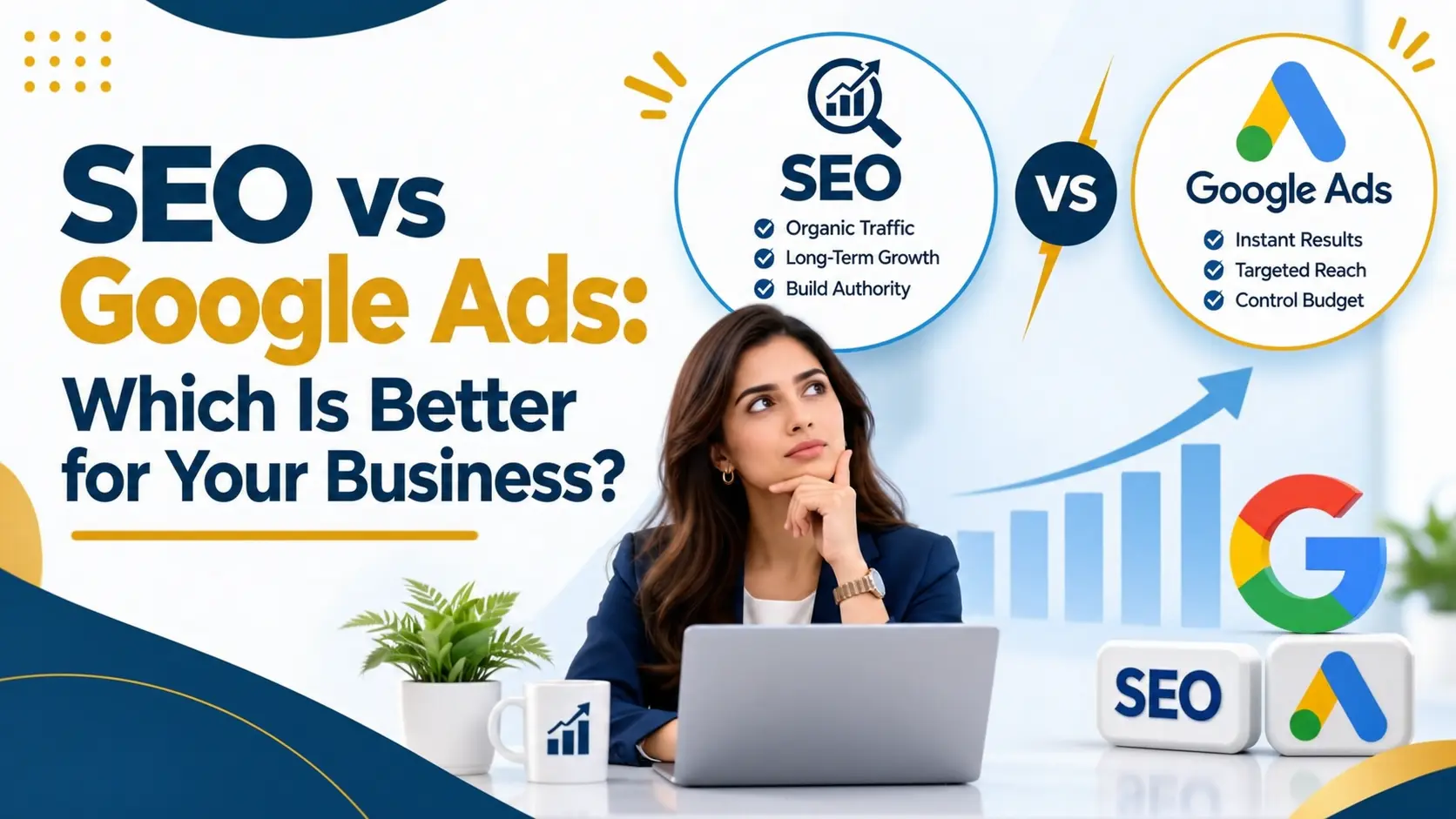
When customers search for a product or service, your business can reach them through organic results or paid ads. SEO builds unpaid search visibility over time. Google Ads purchases visibility through advertising campaigns. The right choice depends on your budget, timeline, competition, sales process, and ability to convert visitors into customers.
SEO is usually better for building sustainable organic visibility and reducing dependence on paid traffic. Google Ads is often better when a business needs immediate, targeted visits or wants to test an offer quickly. Many businesses benefit from using both: Google Ads for short-term demand and SEO for long-term growth.
What Is SEO?
Search engine optimization, or SEO, is the process of improving a website so search engines can crawl, understand and present its pages for relevant searches.
SEO commonly includes:
- Keyword and search-intent research
- Helpful content creation
- On-page optimization
- Technical SEO
- Website architecture
- Internal linking
- Local SEO
- Digital PR and link earning
- Page-experience improvements
- Performance measurement
Google does not charge a business each time someone clicks an organic result. However, SEO is not free. Businesses may need to invest in content, technical work, tools, research, web development and ongoing optimization.
Google describes SEO as helping search engines understand content and helping users find a website through search. It also states that there are no methods that automatically guarantee a first-place ranking.
A useful introduction to the process is available in this explanation of how SEO works in digital marketing.
Practical SEO Example
Consider an accounting firm that wants more business clients.
It could create:
- A main accounting-services page
- Location-specific service pages
- A tax-planning guide
- Answers to common bookkeeping questions
- Case studies showing genuine experience
- Author profiles for qualified contributors
These pages may attract visitors at different stages of the buying journey. Some users are ready to contact an accountant. Others are still researching their options.
What Are Google Ads?
Google Ads is Google’s advertising platform. It allows businesses to pay for placements across Google Search and other eligible Google properties and networks.
For search campaigns, advertisers choose keywords or themes related to their products and services. They create ads, select locations, set budgets and send visitors to relevant landing pages.
Google runs an auction when an eligible search occurs. Ad placement is not determined by bid alone. Google says the auction also considers factors such as ad and landing-page quality, competition, search context, thresholds and the expected effect of ad assets. Google Ads Help
Depending on the campaign type and settings, businesses may pay based on clicks, impressions, views or conversions.
For a wider introduction, review what PPC is and how it works.
Practical Google Ads Example
An emergency plumber may want calls from people searching “24-hour plumber near me.”
A search campaign can target:
- Relevant high-intent queries
- Specific service locations
- Mobile users
- Selected operating hours
- A landing page with a visible phone number
The campaign may begin generating eligible traffic quickly. Results still depend on the offer, competition, budget, ad quality, tracking and landing-page experience.
What Is the Difference Between SEO and Google Ads?
The main difference between SEO and Google Ads is how visibility is earned and maintained.
SEO works to improve a website’s unpaid search presence. Google Ads pays to compete for advertising placements. SEO often requires more time, while ads may deliver traffic soon after an approved campaign becomes active.
| Factor | SEO | Google Ads |
| Placement | Organic search results | Paid advertising placements |
| Traffic speed | Usually gradual | Can begin quickly |
| Per-click charge | No direct search-engine fee | Often charged per click |
| Main investment | Content, expertise and website improvement | Media spend, management and landing pages |
| Visibility duration | Can continue after initial work | Usually falls when campaigns stop |
| Targeting control | Based on relevance and ranking systems | Detailed campaign, audience and location settings |
| Testing speed | Slower | Faster |
| Predictability | Rankings and traffic can change | Budget and targeting offer more direct control |
| Long-term value | Builds reusable content and authority | Produces results while campaigns remain competitive |
| Best use | Sustainable discovery and topic coverage | Immediate demand and controlled testing |
Neither channel guarantees leads or sales. Visibility only creates an opportunity. The website, offer, sales process and customer experience determine what happens next.
How Does Organic Search Compare With Paid Search?
Organic search vs paid search is not simply a choice between free and paid traffic. The channels behave differently and reach users in different ways.
Organic Search
Organic search can attract users across the full customer journey:
- Learning about a problem
- Comparing possible solutions
- Evaluating providers
- Searching for a specific service
- Returning to a known brand
One useful article may attract visitors through several related queries. A strong service page may continue generating enquiries without a charge for each click.
Organic performance can take time. Search engines must discover, crawl, index and evaluate pages. Competition, website history and content quality affect progress.
Paid Search
Paid search can focus quickly on commercial queries. It gives advertisers more control over:
- Target keywords
- Locations
- Devices
- Schedule
- Budget
- Ad messaging
- Landing pages
- Excluded search terms
Paid campaigns are useful when a business knows what it wants users to do. However, paying for traffic does not guarantee conversion. Poor targeting can generate irrelevant clicks, while a weak landing page can waste qualified traffic.
The distinction between organic and non-organic leads also helps explain how acquisition source can affect cost, intent and measurement.
SEO vs Paid Advertising: Which Costs More?
There is no universal answer. Cost depends on the market, competition, website condition, campaign scope and required expertise.
What Does SEO Cost?
SEO expenses may include:
- Technical audits and fixes
- Content planning and writing
- On-page optimization
- Website development
- Digital PR
- Reporting tools
- Ongoing analysis
SEO does not require payment for every organic click. However, competitive results may require sustained investment.
A technically weak site may need development work before content can perform properly. This guide to building an SEO-friendly website explains why site structure, mobile usability and crawlability matter.
What Do Google Ads Cost?
Google Ads expenses may include:
- Advertising spend
- Campaign management
- Keyword research
- Creative development
- Landing-page design
- Conversion tracking
- Testing and optimization
The cost per click changes by keyword, location, competition, quality and search context. A high bid does not automatically secure the best position.
How Should ROI Be Compared?
Compare both channels using business outcomes, not traffic alone.
A simple return calculation is:
ROI = (Revenue attributed to marketing − marketing cost) ÷ marketing cost × 100
For lead-generation businesses, revenue may not occur during the first website visit. A better evaluation may track:
- Cost per qualified lead
- Lead-to-customer rate
- Customer acquisition cost
- Sales value
- Customer lifetime value
- Assisted conversions
- Time to conversion
SEO content may influence a sale before another channel receives the final conversion. Google Ads can also create brand awareness that later produces an organic visit. Attribution should account for this overlap.
What Are the Advantages and Disadvantages of SEO?
Advantages of SEO
- No direct fee for each organic click
- Potential for sustained traffic
- Supports awareness and lead generation
- Builds useful website resources
- Covers informational and commercial searches
- Can strengthen trust and brand visibility
- Supports Google’s AI-powered search experiences
Google says established SEO practices remain relevant to AI Overviews and AI Mode. There is no special markup or separate technical requirement that guarantees inclusion.
Disadvantages of SEO
- Results often take time
- Rankings are not guaranteed
- Competitive markets require ongoing work
- Technical issues can limit performance
- Search visibility can change
- Measurement and attribution can be complex
- Weak or generic content may fail to gain traction
People-first content should provide original value, clear sourcing and genuine expertise. Publishing large amounts of shallow content is not a dependable SEO strategy.
What Are the Advantages and Disadvantages of Google Ads?
Advantages of Google Ads
- Campaigns can generate traffic quickly
- Budgets can be adjusted
- Targeting is highly controllable
- Ad messages can be tested
- Commercial search intent can be targeted
- Campaigns can support launches and seasonal offers
- Conversion tracking can connect clicks with actions
Disadvantages of Google Ads
- Traffic usually declines when spending stops
- Competitive clicks can be expensive
- Poor targeting can waste budget
- Campaigns require regular monitoring
- Tracking errors can lead to weak decisions
- Ad traffic does not guarantee leads
- Policy or account issues can interrupt delivery
Google Ads works best when search terms, ads, offers and landing pages all support the same user need.
SEO or Google Ads: Which Is Better for Your Business?
Businesses asking “SEO or Google Ads—which is better?” should base the decision on goals and constraints.
Choose SEO When:
- You want sustainable organic growth.
- Customers research before purchasing.
- You can invest over a longer period.
- Your industry has many useful content topics.
- You want to build topical authority.
- You need stronger service and location pages.
- You want to reduce long-term dependence on paid traffic.
SEO may suit consultancies, healthcare providers, software companies and professional services with longer buying journeys.
Choose Google Ads When:
- You need traffic quickly.
- You are launching a new offer.
- You want to test demand or messaging.
- Customers use high-intent searches.
- You serve specific locations.
- You can track calls, forms or purchases.
- Your landing page is ready to convert visitors.
Google Ads may suit emergency services, event campaigns, limited-time offers and businesses entering a new market.
Use Both When:
- You need leads while SEO is developing.
- Paid-search data can guide content priorities.
- SEO covers research queries while ads target buyers.
- You want wider search-result visibility.
- You need to reduce dependence on one channel.
- You want to test landing pages before expanding organic content.
For smaller companies, a focused SEO and PPC comparison for small businesses provides additional context on budget and resource constraints.
Can SEO and Google Ads Work Together?
Yes. SEO and Google Ads often perform better as connected channels.
Use Ads Data to Inform SEO
Google Ads can reveal which search terms, offers and landing pages generate meaningful enquiries. This information can help prioritize organic content, but paid results should not be treated as proof that a page will rank organically.
Use SEO Content to Support Paid Campaigns
Useful guides, FAQs and comparison pages can help visitors research a decision after clicking an ad. Strong site content may also improve trust.
Share Landing-Page Insights
Both channels benefit from clear pages with:
- A relevant headline
- A strong value proposition
- Useful supporting information
- Visible contact options
- Mobile-friendly design
- Fast loading
- A focused next step
Conversion improvements can increase the value of both paid and organic traffic. A website conversion-rate optimization process can identify friction between the visit and the desired action.
Measure Combined Business Outcomes
Use consistent conversion definitions across analytics and advertising platforms. Track qualified leads and sales—not only clicks or impressions.
What Actionable Steps Should a Business Take?
Before choosing a channel:
- Define the primary conversion, such as a sale, call or qualified form.
- Calculate an acceptable customer acquisition cost.
- Review current website speed, content and conversion paths.
- Identify high-intent and informational searches.
- Confirm that analytics and conversion tracking work.
- Select a test period and realistic budget.
- Measure lead quality, not only lead volume.
- Review results before increasing investment.
A startup may begin with a focused paid campaign to test its offer. It can then build organic pages around validated customer questions.
An established business may already receive organic traffic but need ads for a new location. A local service company may use SEO for location authority and ads for urgent searches.
The correct mix changes as the business grows.
Final Verdict: SEO vs Google Ads
In the SEO vs Google Ads decision, neither channel is universally better.
Choose SEO when you want to build lasting organic visibility, useful content and topical authority. Choose Google Ads when you need immediate reach, controlled targeting or rapid testing. Use both when short-term demand and long-term growth are equally important.
The strongest strategy begins with clear goals, accurate tracking and a website that can convert relevant visitors. Whether traffic comes from organic search vs paid search, business results depend on what happens after the click.