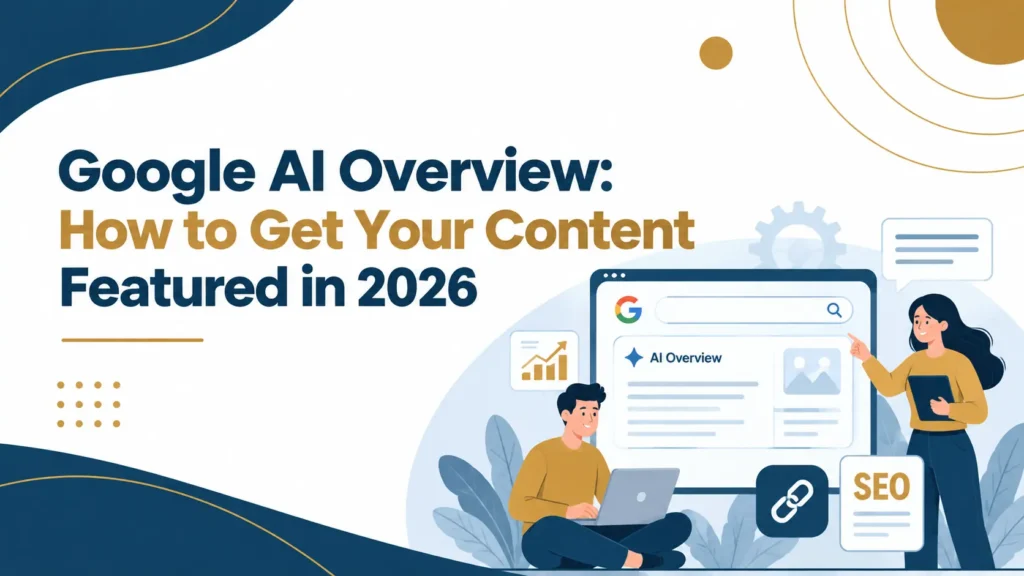
Google AI Overviews are changing how people discover information online. Instead of only showing blue links, Google can now generate AI-powered summaries that answer user questions directly in search results.
For businesses, this creates both risk and opportunity. Some users may click less, but brands featured in AI Overviews can gain visibility, trust, and authority. That is why Google AI Overviews Optimization is now a major part of SEO, GEO, and AEO strategy.
In 2026, ranking is not only about keywords. It is about helpful answers, strong topical authority, expert insights, structured content, trustworthy sources, and clear user intent matching.
To get featured in Google AI Overviews, create helpful content that directly answers user questions, demonstrates E-E-A-T, uses structured data, builds topical authority, and includes clear, concise answer blocks that Google can understand and cite.
Google AI Overviews Optimization is the process of creating trustworthy, structured, and intent-focused content that can be understood and cited by Google’s AI-generated search summaries. It involves implementing E-E-A-T principles, structured data, topical authority, and concise answer-focused content to improve AI search visibility.
What Are Google AI Overviews?
Google AI Overviews are AI-generated summaries shown in Google Search for selected queries. They combine information from multiple sources to give users a quick answer.
They matter because users often want direct, clear answers. If your content is useful, well-structured, and trustworthy, it may have a better chance of being cited or used as a supporting source.
Best practice: Write direct answers first, then explain details below.
How Google AI Overviews Work
Google AI Overviews work by understanding the search query, identifying useful sources, and generating a summarized answer. The system may look for clear explanations, reliable information, relevant entities, and content that matches user intent.
This means your content should be easy to extract. Use clear headings, short answer paragraphs, bullet points, examples, and schema markup where relevant.
Why Google AI Overviews Are Changing SEO Forever
AI Overviews are changing SEO because search is becoming more answer-focused. Users are no longer only searching for pages. They are searching for solutions.
This affects organic traffic because some searches may become zero-click. However, it also creates new visibility opportunities for brands that publish expert, trusted, and well-structured content.
To compete, websites must optimize for:
- Traditional rankings
- Featured snippets
- AI Overviews
- Voice search
- Answer engines
- Generative search platforms
This is where Generative Engine Optimization becomes important.
Google AI Overviews Optimization: Complete Guide
Google AI Overviews Optimization starts with content that answers real questions better than competitors. The goal is to make your page useful for humans and understandable for AI systems.
Create Intent-Focused Content
Search intent means the reason behind a query. A user searching “how to get featured in Google AI Overview” wants a practical process, not vague theory.
Create content for intent types:
- Informational: “What are AI Overviews?”
- How-to: “How to rank in AI Overviews”
- Comparison: “GEO vs SEO”
- Commercial: “best digital marketing agency for AI SEO”
For example, a digital marketing agency targeting “local SEO services” should not only explain what local SEO is. It should answer pricing questions, show case studies, explain ranking factors, include FAQs, and provide a clear service CTA.
For commercial pages, naturally connect readers to a trusted service page such as best digital marketing agency when it helps them take the next step.
Build Topical Authority
Topical authority means covering a subject deeply across many related pages. A single article is not enough.
For example, an SEO website should publish content on:
- Technical SEO
- Content SEO
- Schema markup
- AI search optimization
- Helpful content
- E-E-A-T
- Local SEO
- Link building
- Search Console analysis
You can support this article with an internal guide like Technical SEO Checklist for 2026 to strengthen your topic cluster.
Use Semantic SEO
Semantic SEO helps search engines understand meaning, not just keywords.
For this topic, use related entities such as:
- Google Search
- AI Overviews
- Search Generative Experience
- Structured data
- E-E-A-T
- Helpful content
- Knowledge Graph
- Search intent
- Featured snippets
- Answer Engine Optimization
- Generative Engine Optimization
Semantic coverage helps AI systems understand your content’s context.
Optimize for User Questions
AI search often responds to questions. So, structure sections around questions and answer them quickly.
Use formats like:
- “What is…?”
- “How does…?”
- “Why does…?”
- “What are the best ways to…?”
- “How can beginners…?”
Place a 40–60 word answer below each key heading.
Improve Content Freshness
AI search rewards current and accurate content. Update your articles when Google changes search features, structured data rules, or documentation.
Update:
- Dates
- Screenshots
- Examples
- Statistics
- FAQs
- Schema
- Internal links
- Search Console insights
Freshness matters most when the topic changes quickly.
Add Expert Insights
Generic content is easy to replace. Expert content is harder to ignore.
Add:
- Real project examples
- Case studies
- Screenshots
- Author experience
- Expert quotes
- Original frameworks
- Clear recommendations
- Mistake analysis
This supports E-E-A-T and makes your content more useful.
Top Google AI Overview Ranking Factors
There is no guaranteed formula, but several factors improve AI search visibility.
Content Quality
High-quality content gives complete, accurate, and original answers. It avoids fluff and provides useful examples.
Topical Authority
A website with many strong pages around one topic is easier to trust than a thin site with random articles.
Search Intent Match
Your content should answer the exact question users ask. Do not hide the answer deep inside the page.
Trust Signals
Trust signals include author bios, editorial review, citations, privacy pages, about pages, and transparent business information.
User Experience
A fast, mobile-friendly page with clear formatting improves user satisfaction.
Author Expertise
Show who wrote or reviewed the content. Add credentials, experience, and links to author profiles.
E-E-A-T for AI Overviews
E-E-A-T stands for Experience, Expertise, Authoritativeness, and Trustworthiness.
For AI Overviews, trust is critical. Google wants helpful and reliable information, especially for topics that affect money, health, safety, or business decisions.
Improve E-E-A-T by adding:
- Expert author bio
- Updated publish date
- Editorial policy
- Original examples
- Reliable sources
- Clear disclaimers
- Real business information
- Case studies or proof of experience
Analyze Their PPC and Paid Advertising Skills
Structured data helps search engines understand your page better. It does not guarantee AI Overview placement, but it supports machine readability.
Recommended schema types:
- Article Schema: For blog articles
- FAQ Schema: For question-answer sections
- How-To Schema: For step-by-step guides
- Organization Schema: For brand details
- Author Schema: For writer credibility
- Breadcrumb Schema: For site structure
- WebPage Schema: For page-level context
For example, if your article includes a step-by-step process, How-To Schema can help search engines understand the sequence. If your page answers common questions, FAQ Schema can support better machine readability.
Use schema only when it matches visible page content.
Generative Engine Optimization (GEO) vs Traditional SEO
Feature | Traditional SEO | GEO |
Main Goal | Rank in organic results | Get cited or summarized by AI engines |
Content Style | Keyword + intent focused | Answer + entity focused |
Optimization | Titles, links, content, UX | Concise answers, authority, structure |
Target | Google SERPs | AI Overviews, ChatGPT, Gemini, Perplexity |
Success Metric | Rankings and clicks | Citations, mentions, visibility, assisted traffic |
For a deeper topic cluster, link to Generative Engine Optimization (GEO) from this section.
Answer Engine Optimization (AEO) Strategies
AEO helps your content appear in answer-style results.
Use these strategies:
- Answer the question in the first 2–3 sentences.
- Use simple language.
- Add FAQ sections.
- Create definition boxes.
- Use numbered steps.
- Add comparison tables.
- Include concise summaries.
- Optimize for voice search.
AEO works best when paired with strong SEO and GEO.
How to Rank in Google AI Overviews Faster
Use this step-by-step framework:
- Choose question-based keywords.
- Analyze current AI Overview sources.
- Create a better direct answer.
- Add expert examples.
- Build topical support pages.
- Add structured data.
- Improve page experience.
- Update content regularly.
- Add internal links from related pages.
- Track impressions and clicks in Search Console.
This process improves both traditional SEO and AI search visibility.
Common Mistakes That Prevent AI Overview Visibility
Avoid these mistakes:
- Writing only for keywords
- Hiding direct answers
- Publishing thin content
- Using weak or outdated sources
- Ignoring E-E-A-T
- Missing author information
- Not using schema markup
- Poor internal linking
- Slow page speed
- No content updates
AI systems prefer clarity, authority, and usefulness.
Google AI Overviews Optimization Checklist for 2026
Checklist Item | Status |
Primary question answered in first 100 words | Yes / No |
40–60 word answer blocks added | Yes / No |
Helpful, people-first content | Yes / No |
Expert author bio included | Yes / No |
FAQ section added | Yes / No |
Structured data implemented | Yes / No |
Internal links added | Yes / No |
External authority references added | Yes / No |
Page updated for 2026 | Yes / No |
Mobile and speed optimized | Yes / No |
Content includes examples | Yes / No |
Clear CTA included | Yes / No |
Future of AI Search and SEO
The right agency should think beyond short-term traffic spikes.
A reliable digital marketing agency focuses on:
- Sustainable SEO growth
- Brand authority
- Customer retention
- Lead nurturing
- Long-term ROI
Growth-focused agencies build systems that continue generating leads over time.
Conclusion
Google AI Overviews Optimization is no longer optional for serious SEO growth. In 2026, websites need clear answers, strong E-E-A-T, structured data, topical authority, and user-focused content to compete in both organic search and AI-generated results.
The best approach is simple: answer real questions, show real expertise, keep content fresh, and make your pages easy for both humans and AI systems to understand.
Want your website to appear in Google AI Overviews, ChatGPT Search, Gemini, and Perplexity? Book a free AI SEO audit and discover which pages can be optimized for GEO, AEO, and AI search visibility.
Quick FAQs
Google AI Overviews Optimization is the process of improving content so it can be understood, trusted, and potentially cited by Google’s AI-generated search summaries.
Create helpful content, answer questions clearly, build topical authority, use structured data, improve E-E-A-T, and keep content updated.
Yes. SEO focuses on traditional search rankings, while GEO focuses on visibility in AI-generated answers and generative search engines.
Structured data helps search engines understand your content. It does not guarantee placement, but it supports clarity and eligibility for rich results.
Clear, complete, trustworthy, question-focused content works best. Add direct answers, examples, FAQs, and expert insights.