For many small business owners, digital marketing starts with one big question: Should I invest in SEO or PPC first?
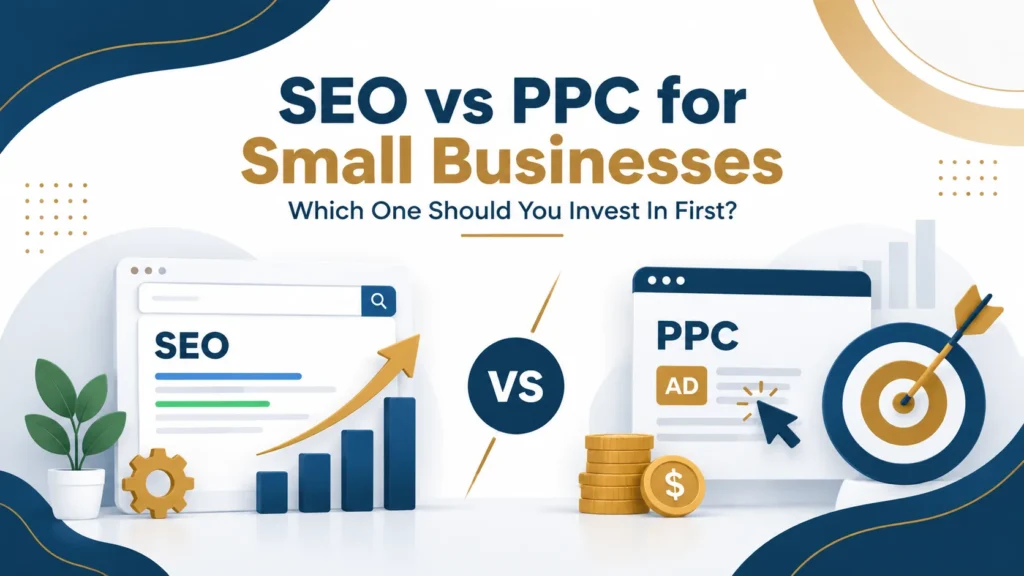
Both SEO and PPC can help your business appear in front of potential customers on Google. But they work in very different ways. SEO focuses on improving your website’s organic visibility in search results, while PPC allows you to pay for ads that appear when people search for your products or services.
Google’s own SEO Starter Guide explains that SEO helps improve your site’s presence in Search, while Google Ads is designed to help businesses reach customers and sell more through paid advertising.
For small businesses with limited budgets, choosing the right channel matters. In this blog, we’ll compare SEO and PPC, explain when to use each, and help you decide which one your business should invest in first.
What Is SEO?
SEO, or Search Engine Optimization, is the process of improving your website so it can rank higher in organic search results.
For example, if you run a local cleaning company, SEO can help your website appear when someone searches:
- cleaning services near me
- office cleaning company
- best home cleaning service
- commercial cleaning services
SEO includes activities like keyword research, content creation, website optimization, technical SEO, local SEO, internal linking, and backlink building.
The biggest benefit of SEO is that it can generate long-term traffic without paying for every click. Once your pages start ranking, they can continue bringing visitors and leads over time.
If you are new to organic search, you can first learn what SEO is and why it matters before comparing it with PPC.
What Is PPC?
PPC stands for Pay-Per-Click advertising. It is a paid marketing model where you pay when someone clicks on your ad.
Google Ads is one of the most popular PPC platforms. With PPC, your business can appear at the top of search results for targeted keywords almost immediately.
For example, if you offer website development services, you can run ads for keywords like:
- web development company
- website design services
- ecommerce website development
- business website developer
The biggest benefit of PPC is speed. Instead of waiting months for rankings, you can start getting clicks, traffic, and leads once your campaign is active.
However, PPC requires a continuous budget. When you stop spending, your ads stop appearing.
To understand paid search in more detail, read our guide on how PPC works
SEO vs PPC: Main Difference
Factor | SEO | PPC |
Traffic Type | Organic | Paid |
Cost Model | Investment in optimization/content | Pay per click |
Speed | Slower, long-term | Faster, immediate |
Duration | Can keep generating traffic | Stops when budget stops |
Best For | Long-term growth | Fast leads and testing |
Trust Factor | Often higher because results are organic | Depends on ad quality and offer |
Budget Need | Consistent monthly SEO work | Ad spend + management |
The biggest difference is that SEO usually brings organic traffic, while PPC brings paid traffic. You can also read our guide on organic and paid leads to understand this difference better.
Benefits of SEO for Small Businesses
1. Long-Term Visibility
SEO is a long-term asset. A well-optimized website can keep attracting visitors even after the original content is published.
For small businesses, this is important because organic traffic can reduce dependency on paid ads over time.
2. Builds Trust and Credibility
Many users trust organic search results because they see them as more natural than ads. If your business appears consistently for relevant searches, it can improve your brand credibility.
3. Better Cost Efficiency Over Time
SEO usually takes time, but once rankings improve, the cost per lead can become lower compared to paid advertising.
HubSpot’s 2026 marketing statistics also show that website, blog, and SEO remain major ROI-generating channels for marketers.
4. Supports Other Marketing Channels
SEO content can also support social media, email marketing, PPC landing pages, and lead nurturing. A helpful blog can be shared across multiple channels.
Limitations of SEO
SEO is powerful, but it is not instant.
Small businesses should know that SEO can take time because Google needs to crawl, index, and evaluate your website. Competitive industries may take longer to show strong results.
Common SEO challenges include:
- Slow ranking growth
- High competition
- Need for regular content
- Technical website issues
- Backlink and authority building
- Algorithm updates
SEO is best for businesses that want sustainable growth and are willing to invest consistently.
Limitations of PPC
PPC can bring fast leads, but it has its own challenges.
The biggest issue is that you need continuous ad spend. Once your budget stops, your traffic stops too.
Other PPC challenges include:
- High cost per click in competitive industries
- Poor landing pages can waste budget
- Wrong keyword targeting can attract low-quality leads
- Campaigns need regular monitoring
- Conversion tracking must be set up correctly
For small businesses, PPC works best when there is a clear offer, strong landing page, proper tracking, and realistic ad budget.
Should Small Businesses Invest in SEO or PPC First?
The answer depends on your business situation.
Choose SEO First If:
Your business should start with SEO if:
- You want long-term growth
- You have a limited monthly ad budget
- Your website already has useful service pages
- Your business depends on local search visibility
- You want to reduce paid ad dependency over time
- You are willing to wait for results
SEO is a smart first investment for businesses that want sustainable visibility and steady organic leads.
Choose PPC First If:
Your business should start with PPC if:
- You need leads quickly
- You are launching a new service
- You have a time-sensitive offer
- Your website is new and has no rankings yet
- You want to test keywords before investing in SEO
- You have budget for ads and campaign management
PPC is useful when speed matters and you need immediate visibility.
Choose Both SEO and PPC If:
The best strategy for many small businesses is to use both together.
PPC can bring leads quickly while SEO builds long-term traffic. Over time, SEO can reduce your dependency on paid ads, while PPC can support campaigns, offers, and competitive keywords.
Example: How SEO and PPC Work Together
Imagine you own a dental clinic.
With PPC, you can immediately run ads for keywords like:
- dentist near me
- emergency dental clinic
- teeth whitening service
At the same time, SEO can help you build long-term rankings for pages like:
- dental clinic in [city]
- cost of teeth whitening
- how to choose a dentist
- dental implant consultation
PPC helps you get visibility now. SEO helps you build authority and organic traffic for the future.
Together, they create a stronger digital marketing strategy.
SEO vs PPC: Which Gives Better ROI?
SEO and PPC can both deliver strong ROI, but the timeline is different.
PPC can generate faster results, but every click has a cost. SEO takes longer, but it can continue producing results without paying for every visit.
For small businesses, the best ROI usually comes from matching the strategy to the business goal:
Business Goal | Better First Choice |
Need leads this month | PPC |
Want long-term traffic | SEO |
Launching a new service | PPC |
Building local visibility | SEO |
Testing offers quickly | PPC |
Reducing ad dependency | SEO |
Scaling lead generation | SEO + PPC |
Common Mistakes Small Businesses Make
1. Running PPC Without a Good Landing Page
Sending paid traffic to a weak homepage can waste budget. PPC works better when users land on a page built for conversion.
2. Expecting SEO to Work Overnight
SEO is not instant. It needs time, content, technical optimization, and consistency.
3. Not Tracking Leads Properly
Whether you use SEO or PPC, tracking is essential. Businesses should track calls, forms, purchases, and other valuable actions.
4. Choosing Keywords Without Understanding Intent
Not every keyword brings customers. Some keywords attract students, job seekers, or people looking for free information. Small businesses should focus on buyer-intent keywords.
5. Treating SEO and PPC Separately
SEO and PPC perform better when they support each other. PPC keyword data can improve SEO content, and SEO landing pages can improve ad performance.
Conclusion
SEO and PPC are both valuable digital marketing strategies for small businesses.
SEO helps you build long-term visibility, trust, and organic traffic. PPC helps you reach customers quickly and generate leads faster. Instead of choosing one forever, small businesses should understand their goals, budget, competition, and timeline.
At Maltar Services, we help businesses create result-focused digital marketing strategies using SEO, PPC, web development, social media marketing, and email marketing.
Understanding the importance of online marketing can help small businesses choose the right mix of SEO, PPC, social media, and email marketing.
Need help deciding whether SEO or PPC is right for your business? Contact Maltar Services today and let our team build a strategy that fits your goals.
Quick FAQs
SEO is better for long-term growth, while PPC is better for quick results. If your business wants steady traffic and leads over time, SEO is a strong choice. If you need immediate enquiries or want to promote a time-sensitive offer, PPC may be better.
You should invest in SEO first if you want long-term visibility and have time to grow. You should invest in PPC first if you need leads quickly or want to test a new service, offer, or market. For the best results, many small businesses use both together.
PPC can become expensive because you pay for every click. SEO also needs investment, but it can become more cost-effective over time because organic traffic does not require payment for each visit.
SEO usually takes a few months to show noticeable results, depending on your website, competition, keywords, content quality, and technical optimization. It is a long-term strategy, not an instant solution.