If you’ve spent any time in digital marketing lately, you’ve probably noticed something: the old way of doing SEO — hours of manual keyword research, spreadsheet-heavy audits, and gut-feeling content decisions — is quietly being replaced by something far more intelligent.
AI-powered SEO agents are reshaping how businesses approach search engine optimization. These aren’t just tools that automate a task here and there. They’re autonomous systems that can research, plan, execute, and iterate SEO strategies with minimal human input.
According to a 2024 survey by BrightEdge, over 68% of marketers now use AI in some form in their SEO workflows. And among those who’ve adopted AI agents specifically, nearly 80% reported measurable improvement in organic traffic within 90 days.
That’s not a minor efficiency gain. That’s a paradigm shift.
In this guide, you’ll get a complete breakdown of what AI-powered SEO agents are, how they work, which ones are worth your time, and exactly how to use them to outrank your competitors in 2026
What Are AI-Powered SEO Agents?
Let’s start with the basics — because the term gets thrown around loosely.
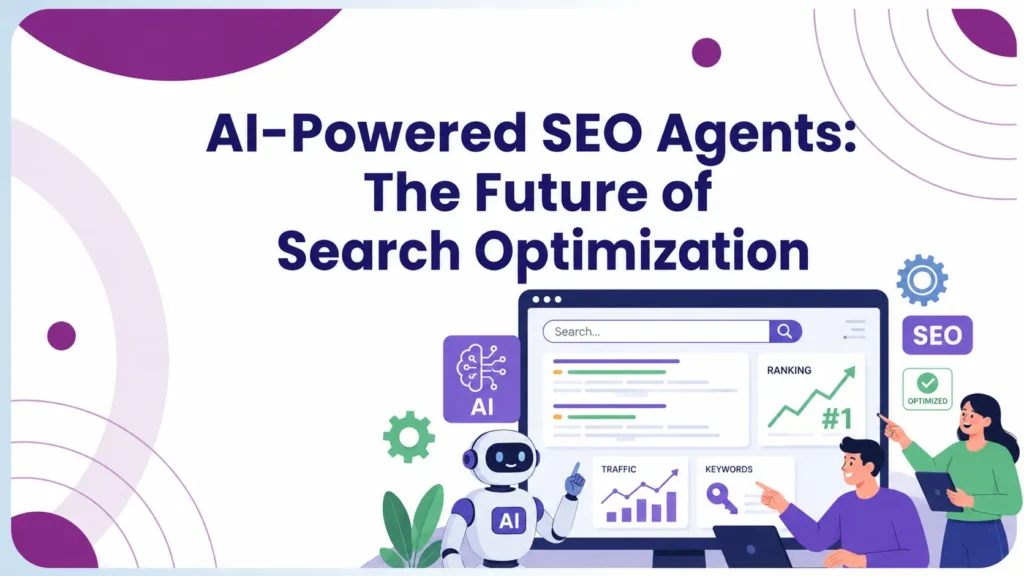
An AI-powered SEO agent is an autonomous software system that uses large language models (LLMs), machine learning, and natural language processing (NLP) to perform SEO tasks independently. Unlike traditional SEO tools that give you data and wait for you to act, an AI agent can:
- Analyze your website’s current performance
- Identify gaps, opportunities, and threats
- Execute optimizations directly or generate detailed action plans
- Adapt based on results and changing SERP dynamics
Think of it like the difference between a GPS app that shows you a map versus one that drives the car for you.
The underlying technology typically combines:
- LLMs (like GPT-4, Claude, or Gemini) for content understanding and generation
- Web crawlers for data collection
- SERP analysis APIs for real-time competitive intelligence
- Agentic frameworks (like LangChain, AutoGPT, or CrewAI) that allow the AI to plan and execute multi-step tasks
The Agentic Difference
What separates an AI agent from an AI tool is autonomy and chaining.
A regular AI tool answers a single question: “What keywords should I target?”
An AI agent answers, then acts: “Here are the keywords. I’ve already created content briefs for the top 10, clustered them by intent, and drafted outlines for your editorial team. Want me to start on the meta descriptions too?”
That’s the power shift. And it’s why forward-thinking SEO teams are adopting agents fast.
How AI SEO Agents Actually Work
Understanding the mechanics helps you use these tools more effectively.
Step 1: Goal Setting and Task Decomposition
You give the agent a high-level objective — say, “Increase organic traffic to our blog by 40% in 6 months.”
The agent breaks this into sub-tasks:
- Audit existing content
- Research top-ranking competitor pages
- Identify keyword gaps
- Prioritize pages for optimization
- Create content briefs for new articles
- Track changes and results
Step 2: Data Gathering
The agent pulls data from multiple sources simultaneously:
- Google Search Console (via API)
- SEMrush, Ahrefs, or Moz (via integration)
- Live SERP scraping
- Your CMS or website directly
This happens in seconds — what would take a human analyst hours.
Step 3: Analysis and Pattern Recognition
Using machine learning models trained on billions of search results, the agent identifies:
- Which content formats Google currently rewards in your niche
- Semantic keyword clusters with high topical authority potential
- Internal linking gaps that are costing you crawl equity
- E-E-A-T signals your competitors have that you don’t
Step 4: Action and Execution
Depending on the platform, the agent either:
- Generates recommendations for your team to execute
- Directly implements changes via CMS integrations (e.g., WordPress, Webflow)
- Creates content drafts optimized for target keywords
- Sends alerts when rankings shift or algorithm updates occur
Step 5: Monitoring and Iteration
Good AI SEO agents don’t just run once. They continuously monitor:
- Ranking changes after updates
- Competitor content moves
- New keyword opportunities as search trends evolve
This feedback loop is what makes them genuinely powerful over time.
Core Capabilities: What Can They Do?
Here’s a comprehensive breakdown of what modern AI-powered SEO agents can handle:
Keyword Research & Clustering
Manual keyword research used to mean exporting thousands of rows from a tool and spending hours grouping them. AI agents:
- Automatically cluster keywords by semantic similarity and search intent
- Identify long-tail opportunities with high conversion potential
- Map keywords to your existing content to avoid cannibalization
- Predict emerging search trends before they peak
Example: An agent might discover that while you’re targeting “best project management software,” there’s a rising cluster around “AI project management tools for remote teams” — a less competitive phrase with a faster-growing search volume.
Content Optimization
AI agents can analyze your existing pages against top-ranking competitors and tell you:
- Which NLP entities are missing from your content
- What semantic gaps exist compared to #1-ranked pages
- Optimal content length, structure, and heading hierarchy for your query
- Where to naturally incorporate LSI keywords without keyword stuffing
Technical SEO Auditing
Technical SEO has always been one of the most complex parts of the discipline. AI agents can crawl your entire site and flag:
- Crawlability issues (orphan pages, broken links, redirect chains)
- Core Web Vitals failures
- Structured data (schema markup) gaps
- Mobile usability issues
- Duplicate content problems
- XML sitemap inconsistencies
What used to take a senior SEO consultant a week? An AI agent can do it in under an hour.
Link Building Intelligence
AI agents now assist with:
- Identifying high-authority link opportunities in your niche
- Analyzing competitor backlink profiles for gaps
- Drafting personalized outreach emails at scale
- Finding broken link opportunities on relevant websites
- Monitoring your existing backlink profile for toxic links
Competitive Intelligence
Understanding your SERP competitors at a deep level used to require significant manual research. AI agents can:
- Reverse-engineer exactly what content strategy your top competitors are executing
- Track competitor content publishing cadence
- Alert you when a competitor publishes content targeting your top keywords
- Identify competitor weaknesses you can exploit
Rank Tracking & Reporting
Beyond simple position monitoring, AI agents generate:
- Natural-language performance summaries (“Your blog section gained 340 clicks this week, primarily from updated FAQ content”)
- Predictive forecasts for traffic growth scenarios
- Automated client-ready reports
- Anomaly detection alerts when traffic drops unexpectedly
Top AI SEO Agent Tools in 2026
|
Tool |
Best For |
Key AI Feature |
Price Range |
|
Surfer SEO + AI |
Content optimization |
NLP-based content scoring |
$89–$249/mo |
|
Semrush Copilot |
All-in-one SEO |
AI recommendations across all modules |
$130–$500/mo |
|
Ahrefs AI |
Link building & research |
AI-assisted content gaps analysis |
$99–$399/mo |
|
MarketMuse |
Topical authority |
AI content planning & clustering |
$149–$999/mo |
|
Alli AI |
Technical SEO automation |
Bulk on-page optimization at scale |
$299–$1,500/mo |
|
BrightEdge Copilot |
Enterprise SEO |
Real-time content intelligence |
Custom pricing |
|
Jasper + Surfer |
Content + SEO combo |
Brief-to-draft pipeline |
From $49/mo |
|
AgentSEO |
Autonomous agents |
Multi-step autonomous SEO execution |
From $199/mo |
Which Tool Is Right for You?
- Solo content creators & bloggers: Start with Surfer SEO’s AI features — the learning curve is low and the content scoring is immediately useful.
- Growing businesses (5–50 person teams): Semrush Copilot gives you the broadest coverage without needing multiple subscriptions.
- Enterprise SEO teams: BrightEdge or Alli AI for scale and automation across thousands of pages.
- Agencies: MarketMuse’s topical mapping plus AgentSEO’s autonomous features creates a powerful combination.
Real-World Use Cases
Case Study 1: E-Commerce Store — 213% Traffic Growth
A mid-sized e-commerce brand selling home fitness equipment used an AI agent (Semrush Copilot + custom GPT-4 integration) to:
- Audit 4,200 product pages in 2 days
- Identify 847 pages with thin content
- Generate optimized product descriptions for top 200 priority pages
- Build an internal linking structure connecting blog content to product pages
Result: 213% increase in organic traffic in 5 months. Revenue from organic search up 178%.
Case Study 2: B2B SaaS — Topical Authority in 90 Days
A project management SaaS company used MarketMuse to build topical authority in their niche:
- AI mapped 60 content pieces needed to dominate their topic cluster
- Prioritized 15 “pillar” pieces and 45 supporting articles
- Generated detailed content briefs with semantic NLP recommendations
Result: Ranked on page 1 for 23 high-intent keywords within 90 days. Demo request rate from organic search increased by 41%.
Case Study 3: Local Business — Dominating Local Pack
A regional law firm used an AI agent to optimize 47 service pages for local SEO:
- Identified local semantic keywords human research had missed
- Optimized Google Business Profile content
- Automatically added FAQ schema to top pages
Result: Moved from position 8 to position 2 in the Google Local Pack for their primary practice area keywords. Inbound calls up 67%.
Benefits and Limitations
Speed at Scale What a team of 5 SEOs can do in a month, an AI agent ecosystem can begin executing in days. For businesses with large websites, this efficiency gain is transformational.
Data-Driven Decision Making AI agents remove the guesswork. Every recommendation is backed by SERP data, not opinion.
24/7 Monitoring Algorithms don’t take weekends off. Neither do AI agents. You get real-time alerts and continuous optimization.
Democratization of SEO Small businesses that couldn’t afford a full-time SEO team can now access enterprise-grade optimization capabilities.
Reduced Human Error SEO involves many repetitive tasks where mistakes happen. Automation reduces errors in technical implementations, meta tag optimization, and bulk content updates.
Limitations and Challenges
Lack of True Creativity AI agents excel at pattern recognition, but genuine creative insight — a truly unique angle on a topic — still requires human thinking.
Over-Optimization Risk Without careful oversight, AI agents can produce content that’s technically optimized but reads as robotic or hollow. Google’s Helpful Content System penalizes this.
Data Dependency AI agents are only as good as the data they access. If your analytics are poorly set up, the agent’s recommendations will be flawed.
Initial Setup Complexity Enterprise AI SEO implementations require significant technical setup, API integrations, and workflow configuration.
Cost Premium AI SEO agent platforms aren’t cheap. For small businesses, the ROI math needs careful calculation upfront.
Ethical Considerations Automated link building and mass AI-generated content without human review can cross into practices that violate Google’s guidelines.
AI SEO Agents vs. Traditional SEO Tools
It’s worth being precise about what’s genuinely new here.
|
Capability |
Traditional SEO Tools |
AI SEO Agents |
|
Keyword Research |
Provides data; you interpret |
Interprets data; prioritizes actions |
|
Content Brief Creation |
Manual process |
Automated, NLP-enhanced |
|
Technical Auditing |
Flags issues; you fix |
Flags + can auto-fix (in some platforms) |
|
Competitive Analysis |
Data export + manual review |
Automatic pattern recognition + narrative insights |
|
Reporting |
Raw data dashboards |
Natural language summaries + predictive analytics |
|
Adaptation |
Requires manual updates |
Self-updates based on new SERP data |
|
Learning |
Static (you learn from it) |
Dynamic (it learns from results) |
The bottom line: traditional tools give you information. AI agents give you intelligence + action.
How to Implement AI SEO Agents in Your Strategy
Here’s a practical, step-by-step framework for integrating AI SEO agents without disrupting your current workflow:
Phase 1: Foundation (Weeks 1–2)
Audit Your Data Infrastructure
- Ensure Google Search Console and Google Analytics 4 are properly configured
- Connect your primary SEO tool (Ahrefs/Semrush) via API
- Define your core KPIs and baseline metrics
Choose Your Agent Stack
- Pick one core platform (see the tools table above)
- Start with a single use case (content optimization OR technical auditing — not both at once)
Phase 2: Pilot (Weeks 3–6)
Run a Controlled Test
- Select 20–30 pages for optimization
- Let the AI agent analyze and generate recommendations
- Have a human SEO review all suggestions before implementing
- Implement changes and document baseline rankings
Build Your Feedback Loop
- Set up weekly performance tracking
- Note where agent recommendations performed well vs. poorly
- Use these learnings to refine your agent’s configuration
Phase 3: Scale (Months 2–6)
Expand to More Page Categories
- Roll out to broader page sets based on pilot results
- Introduce automation for lower-risk tasks (meta descriptions, title tags)
- Keep human review for high-stakes decisions (major content overhauls, disavow files)
Integrate Across Teams
- Connect AI agent outputs to your content team’s editorial calendar
- Share agent-generated reports with stakeholders automatically
- Build custom dashboards for different team members
Phase 4: Advanced Optimization (Month 6+)
Custom Agent Workflows
- Build custom prompts and workflows for your specific industry
- Train agents on your brand voice and content standards
- Explore multi-agent setups where specialized agents handle specific tasks
The Future of AI in SEO
Fully Autonomous SEO Campaigns
Within 2–3 years, we’ll see AI agents that can run entire SEO campaigns with minimal human oversight — from strategy to execution to optimization — checking in with humans only for major strategic decisions.
AI-to-AI Search
As AI search tools (Perplexity, ChatGPT Search, Google AI Overviews) become mainstream, SEO will increasingly mean optimizing for AI systems that summarize content rather than serving up traditional blue links. AI SEO agents will be specifically trained to optimize for AI-readable content structures.
Real-Time Algorithm Adaptation
Future AI SEO agents will detect Google algorithm updates in real-time and automatically adjust content and technical optimizations before you even know an update happened.
Hyper-Personalization at Scale
AI agents will eventually tailor content experiences for different user segments dynamically — serving different content variations to different audiences while maintaining SEO performance across all versions.
Voice and Multimodal Search Optimization
As voice search and image search grow, AI SEO agents will expand their capabilities beyond text to optimize for multimodal search queries — a genuinely new frontier.
Conclusion
AI-powered SEO agents aren’t a distant future technology. They’re here, they work, and the businesses leveraging them right now are pulling ahead of competitors still doing SEO the manual way.
But let’s be clear: they’re not magic. The organizations seeing the best results are those that treat AI agents as a force multiplier for skilled SEO thinking not a replacement for it.
Start with one use case. Learn how the agent thinks. Validate its recommendations. Iterate. Scale.
The search landscape is evolving faster than it ever has. The question isn’t whether to adopt AI-powered SEO tools it’s how quickly you can do it intelligently.
The teams who figure that out will own their niches. The ones who wait will be playing catch-up for years.
Quick FAQs
An AI-powered SEO agent is an autonomous software system that uses artificial intelligence — including large language models, machine learning, and NLP — to perform SEO tasks independently. Unlike traditional tools that provide data for humans to act on, AI agents can plan, execute, and iterate SEO strategies with minimal human involvement.
Not better — different. AI agents outperform humans in speed, scale, and data processing. Humans outperform AI in creative strategy, relationship building (essential for link building), brand voice calibration, and navigating complex, nuanced decisions. The most effective approach combines both.
Using AI agents for SEO analysis, technical optimization, and content research is perfectly safe. The risk comes from publishing mass AI-generated content without human review, or using AI to pursue aggressive link schemes. Always review AI outputs and ensure they meet Google's quality guidelines for helpful, reliable, people-first content.
Pricing ranges widely. Entry-level tools like Surfer SEO start around $89/month. Mid-tier platforms like Semrush's AI features range from $130–$500/month. Enterprise solutions like BrightEdge and Alli AI can run from $1,500 to $10,000+/month. ROI calculations should factor in hours saved versus the subscription cost.
Absolutely. In fact, AI SEO agents level the playing field. A small business owner with limited SEO knowledge can now access analysis and optimization capabilities that previously required a full-time SEO team. Tools like Surfer SEO and Semrush's AI Copilot are particularly accessible for smaller operations.