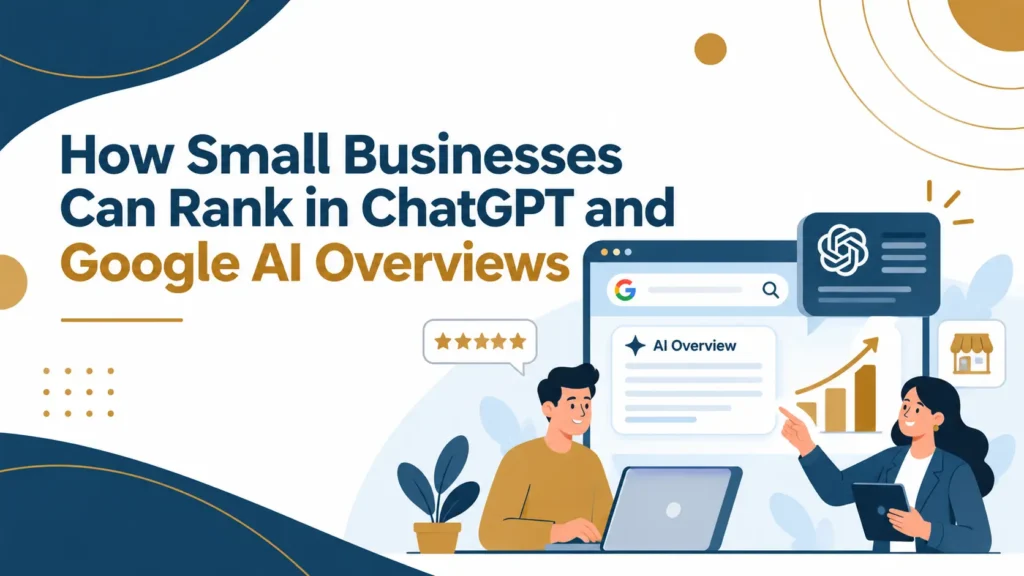
Small businesses can rank in ChatGPT and Google AI Overviews by publishing helpful, expert-led content that answers real questions, builds topical authority, uses clear entities, earns brand mentions, keeps technical SEO clean, and supports trust with reviews, case studies, structured data, and local SEO signals.
What Are AI Search Engines?
AI search engines are tools that answer user questions with summarized information instead of only showing blue links. Examples include ChatGPT Search, Google AI Overviews, Gemini, Perplexity, Claude, and Bing Copilot. They often pull from web pages, brand mentions, structured data, and trusted sources.
For small businesses, this means your content must be easy to find, easy to understand, and easy to cite. Traditional SEO still matters, but AI search rewards clear answers, strong entities, original experience, and credible content.
What Is Google AI Overviews?
Google AI Overviews are AI-generated summaries that appear in Search when Google believes a generated answer can help users understand information from multiple sources. Google says AI features still rely on foundational Search best practices, including helpful content, technical accessibility, and structured data that matches visible page content.
For small businesses, AI Overviews can create both risk and opportunity. You may receive fewer clicks for simple answers, but you can gain visibility if your website becomes a trusted source for specific services, locations, industries, and problems.
How AI Search Differs From Traditional Google Search
AI search does not only rank pages. It selects, summarizes, compares, and cites information. That means your content must answer questions clearly, show expertise, and explain concepts in a way machines can extract.
| Factor | Traditional SEO | AI SEO / GEO |
| Main goal | Rank pages | Become a cited answer source |
| Format | Keywords and pages | Answers, entities, summaries |
| Trust | Backlinks and quality | EEAT, mentions, reviews, sources |
| Content style | Full page ranking | Extractable answer blocks |
| Optimization | SEO fundamentals | SEO + GEO + AEO |
Google’s helpful content guidance says content should be made for people first, not mainly to manipulate rankings. That same principle applies to AI search.
Why AI Search Matters for Small Businesses
AI search matters because buyers now ask full questions, such as “Which local SEO agency helps small businesses rank in AI Overviews?” or “Who offers technical SEO services for healthcare websites?” AI tools may recommend brands that have clear expertise, strong service pages, helpful blogs, case studies, and consistent online mentions.
This is important for service businesses, SaaS companies, clinics, real estate agencies, consultants, e-commerce brands, and local companies. Strong AI search visibility can support trust before users even visit your website.
For broader planning, read Maltar Services’ guide on digital marketing strategies for small businesses.
AI Search Ranking Factors
AI systems choose sources based on relevance, clarity, trust, and authority. There is no single “ChatGPT ranking factor,” but small businesses can improve visibility by strengthening the signals AI systems can understand.
Key factors include:
- Helpful, original content
- Strong topical authority
- Clear brand and service entities
- EEAT signals
- Schema markup
- Fast, mobile-friendly pages
- Internal linking
- Reviews and case studies
- Local SEO signals
- Digital PR and brand mentions
- Fresh, updated content
Google added “Experience” to its quality guidance, making first-hand knowledge more important for trust evaluation. This is why real examples, client stories, screenshots, and case studies matter.
SEO vs GEO vs AEO
| Type | Meaning | Purpose |
| SEO | Search Engine Optimization | Rank in Google search results |
| GEO | Generative Engine Optimization | Appear in AI-generated answers |
| AEO | Answer Engine Optimization | Answer direct questions clearly |
A strong strategy uses all three. SEO gets your pages indexed and ranked. GEO helps AI tools understand your authority. AEO helps your content answer questions in featured snippets, People Also Ask, and AI responses.
For deeper GEO learning, check: Generative Engine Optimization guide
How Small Businesses Can Improve AI Visibility
Small businesses can improve AI search visibility by building content that clearly explains who they help, what they do, where they operate, and why they are trustworthy. AI systems need clean signals, not vague marketing copy.
1. Build Entity-Based Service Pages
Create clear pages for SEO services, Local SEO, Technical SEO, PPC, web development, CRO, and AI SEO. Each page should answer:
- What is the service?
- Who is it for?
- What problem does it solve?
- What process do you follow?
- What proof supports your expertise?
2. Publish Helpful Topic Clusters
Do not publish random blogs. Build clusters around core services.
Example SEO cluster:
- SEO basics
- Technical SEO checklist
- On-page SEO
- Backlinks
- Content optimization
- SEO mistakes
- SEO case studies
3. Add Original Proof
AI search favors content that adds unique value. Add case studies, original data, before-and-after examples, screenshots, client results, and expert commentary.
4. Improve Local SEO Signals
For local businesses, AI visibility depends heavily on location clarity. Keep your Google Business Profile, reviews, citations, service areas, and website content consistent.
Local AI queries often include phrases like “near me,” “best agency for small business,” or “SEO company in Dubai.” Your website should mention your target regions naturally, including the US, UK, Canada, Australia, UAE, Singapore, and Germany.
5. Use Structured Data
Schema helps search engines understand your content. Use Organization, LocalBusiness, Article, FAQPage, BreadcrumbList, Service, Review, and Author schema where relevant. Schema.org provides the shared vocabulary used for structured data across search systems.
6. Keep Technical SEO Clean
AI tools cannot cite pages they cannot access or understand. Fix crawl errors, slow pages, poor mobile UX, broken links, duplicate titles, thin content, and missing schema.
AI SEO Checklists
AI SEO Checklist
- Answer the main question in the first 100 words
- Use simple headings
- Define key terms
- Add comparison tables
- Include FAQs
- Add expert examples
- Link to related pages
- Keep content updated
Google AI Overviews Checklist
- Write helpful people-first content
- Use clear author and company information
- Match schema to visible content
- Add original examples
- Build topical authority
- Improve page speed and mobile UX
ChatGPT Visibility Checklist
- Build strong brand mentions
- Publish clear service pages
- Use consistent entity names
- Create comparison content
- Add expert-led blog posts
- Earn citations from trusted sites
Technical SEO Checklist
- Fix indexing issues
- Improve Core Web Vitals
- Use HTTPS
- Add XML sitemap
- Clean robots.txt
- Fix broken links
- Optimize mobile layout
Content Quality Checklist
- Clear answer
- Original insight
- Simple language
- Expert review
- Recent update date
- Useful examples
- No keyword stuffing
- Strong internal links
Common Mistakes
Many small businesses fail in AI search because their content is too thin, too generic, or too sales-heavy. AI systems need clear answers and trust signals.
Avoid these mistakes:
- Writing only for keywords
- Publishing duplicate service pages
- Ignoring local SEO
- No author or reviewer details
- No case studies
- Weak internal linking
- Missing schema
- Outdated blog content
- Slow mobile pages
- No brand mentions outside the website
Future of AI Search
AI search will keep changing how people discover businesses. Search is moving from keyword matching to answer selection. Small businesses that build trust, publish useful content, and prove real-world expertise will have a stronger chance of being cited.
This does not replace SEO. It expands SEO into AI visibility, entity trust, answer optimization, and brand authority.
Conclusion
Small businesses can rank in ChatGPT and Google AI Overviews by becoming the clearest and most trusted answer for their audience. The winning strategy is simple: publish useful content, build topical authority, improve technical SEO, add proof, earn mentions, and keep your brand information consistent.
Maltar Services helps businesses improve AI SEO, GEO, Local SEO, Technical SEO, content marketing, and Google AI Overviews visibility with a practical, search-first strategy. For a focused next step, explore Maltar as a full-service digital marketing agency or request an AI SEO visibility audit.